raphael daibert
hearing from, gathering with, writing towards, learning otherwise
artistic research


Design: Carlo Canún
This curatorial and artistic research stems from noticing and observing the prominent scrotums of equestrian statues. Mostly present in main squares, parks or centers of cities, no matter where in the world, this kind of sculpture is almost omnipresently of a male figure on a horse. They are physical representations of historical facts and were created and installed in public spaces as marks of a specific remembrance narrative, as monuments of victory. The overexposure of normative masculine symbols applied to a horse shows an animal that, throughout history, has been domesticated to not only serve, but maximize strength and virility. To state power.
Why can't horse statues be mares? conjures the figure of a mare with the intention to break this imaginary. An anticolonial proposition to counterpoint and invoke who should actually be remembered and, why not, monumentalized. Moved by a queer critique perspective, this investigation wishes to address, criticize, respond and satirize this hegemonical way of representing history by evoking historical art works from queer artists.
Taking the horse, or rather, the mare as the point of departure, the selection of artists gather examples of action, intervention, performance and text that subvert a certain order imposed by political repressive regimes and patriarchal logics.
Why can't horse statues be mares? conjures the figure of a mare with the intention to break this imaginary. An anticolonial proposition to counterpoint and invoke who should actually be remembered and, why not, monumentalized. Moved by a queer critique perspective, this investigation wishes to address, criticize, respond and satirize this hegemonical way of representing history by evoking historical art works from queer artists.
Taking the horse, or rather, the mare as the point of departure, the selection of artists gather examples of action, intervention, performance and text that subvert a certain order imposed by political repressive regimes and patriarchal logics.
🐴 The first iteration and launch of this project with take the format of a walk in Munich – on Sept 19th 2026, at Haus der Kunst ︎︎︎
https://www.hausderkunst.de/en/events/open-salon-with-cruising-curators-and-the-rerouting-project-290719
Photos: Tanja Kernweiss
![]()
![]()
![]()
![]()
![]()
![]()
![]()
![]()
![]()
![]()
![]()
![]()
![]()
![]()
![]()
![]()
![]()
![]()
![]()
![]()
![]()
https://www.hausderkunst.de/en/events/open-salon-with-cruising-curators-and-the-rerouting-project-290719
Photos: Tanja Kernweiss


book: walk notations


Walk Notations brings together traces emerging from Dissident Paths: Walking Together as a Method, a series of artistic walks across Berlin in 2025. Moving between artistic practices, curatorial conversations, and reflections, the book approaches walking as a method for being together in public space. Some contributions revisit specific sites or gestures while others move further afield, driven by personal memory, archival research, theoretical analysis, or speculative fiction. Conceived as a portable companion, Walk Notations invites the readers to navigate the city otherwise—attentive to detours, thresholds, and the possibilities that emerge when paths are made collectively.
Besides taking part of the general conceptualization and production of the book, I'm very glad to have written the text The Curatorial as Contact: Practicing With and Through Each Other as well as being in dialogue with the other curators of the project in the conversation text entitled A Flashlight, Two Whistles, and Twenty or So Mortars and Pestles.
Besides taking part of the general conceptualization and production of the book, I'm very glad to have written the text The Curatorial as Contact: Practicing With and Through Each Other as well as being in dialogue with the other curators of the project in the conversation text entitled A Flashlight, Two Whistles, and Twenty or So Mortars and Pestles.
📚️ get your copy at ︎︎︎
https://ngbk.de/en/shop/publikationen/01-walk-notations
Ed.: Eirini Fountedaki, nGbK Press
With contributions by: Alternative Monument, Yasmeen Al-Qaisi, Elena Biserna, Mirja Busch, Clementine Butler-Gallie, Suelen Calonga, Saverio Cantoni, Bengisu Çağlayan, Raphael Daibert, Eirini Fountedaki, Carolin Genz, handbreastheart kollektiv, House’ it going?, Gabriel Francisco Lemos, Luise Leon Elbern, Mahshid Mahboubifar, Pol Merchan, Harun Morrison, Pitchaya Ngamcharoen, Marlene Oeken & Martha Schwindling, Minh Duc Pham, Project In/Visibility, Liz Rosenfeld, Natthapong Samakkaew, Kaspar Schmidt Mumm, ssssSssssssss (Ashkan Sepavand and virgil b/g taylor), Viviane Tabach, Sarnt Utamachote
Graphic design: Paula Buškevica
The publication is primarily in English, with selected contributions in German.
photos by Lucía Alfaro Valencia & me.
https://ngbk.de/en/shop/publikationen/01-walk-notations
Ed.: Eirini Fountedaki, nGbK Press
With contributions by: Alternative Monument, Yasmeen Al-Qaisi, Elena Biserna, Mirja Busch, Clementine Butler-Gallie, Suelen Calonga, Saverio Cantoni, Bengisu Çağlayan, Raphael Daibert, Eirini Fountedaki, Carolin Genz, handbreastheart kollektiv, House’ it going?, Gabriel Francisco Lemos, Luise Leon Elbern, Mahshid Mahboubifar, Pol Merchan, Harun Morrison, Pitchaya Ngamcharoen, Marlene Oeken & Martha Schwindling, Minh Duc Pham, Project In/Visibility, Liz Rosenfeld, Natthapong Samakkaew, Kaspar Schmidt Mumm, ssssSssssssss (Ashkan Sepavand and virgil b/g taylor), Viviane Tabach, Sarnt Utamachote
Graphic design: Paula Buškevica
The publication is primarily in English, with selected contributions in German.
photos by Lucía Alfaro Valencia & me.
curating
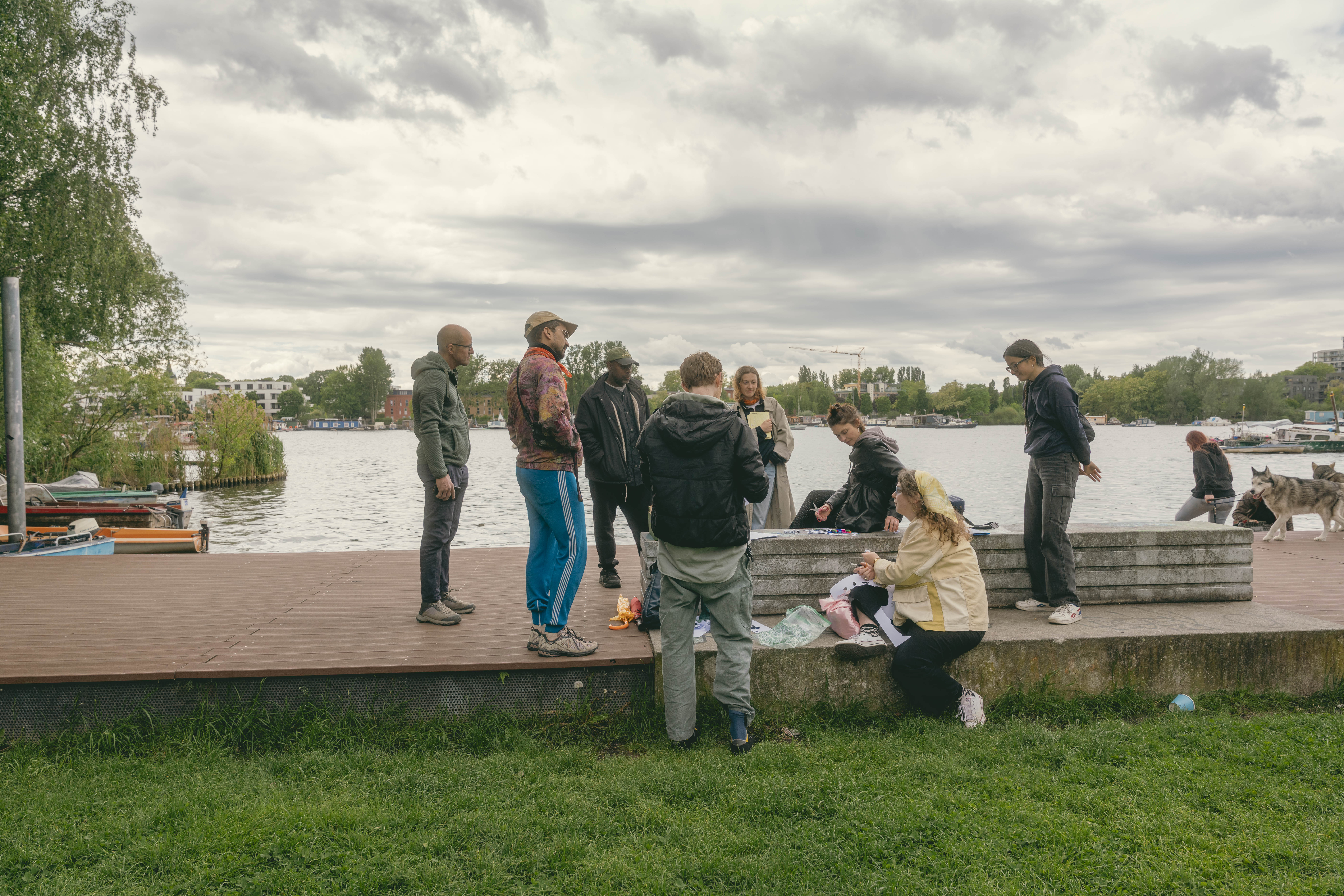


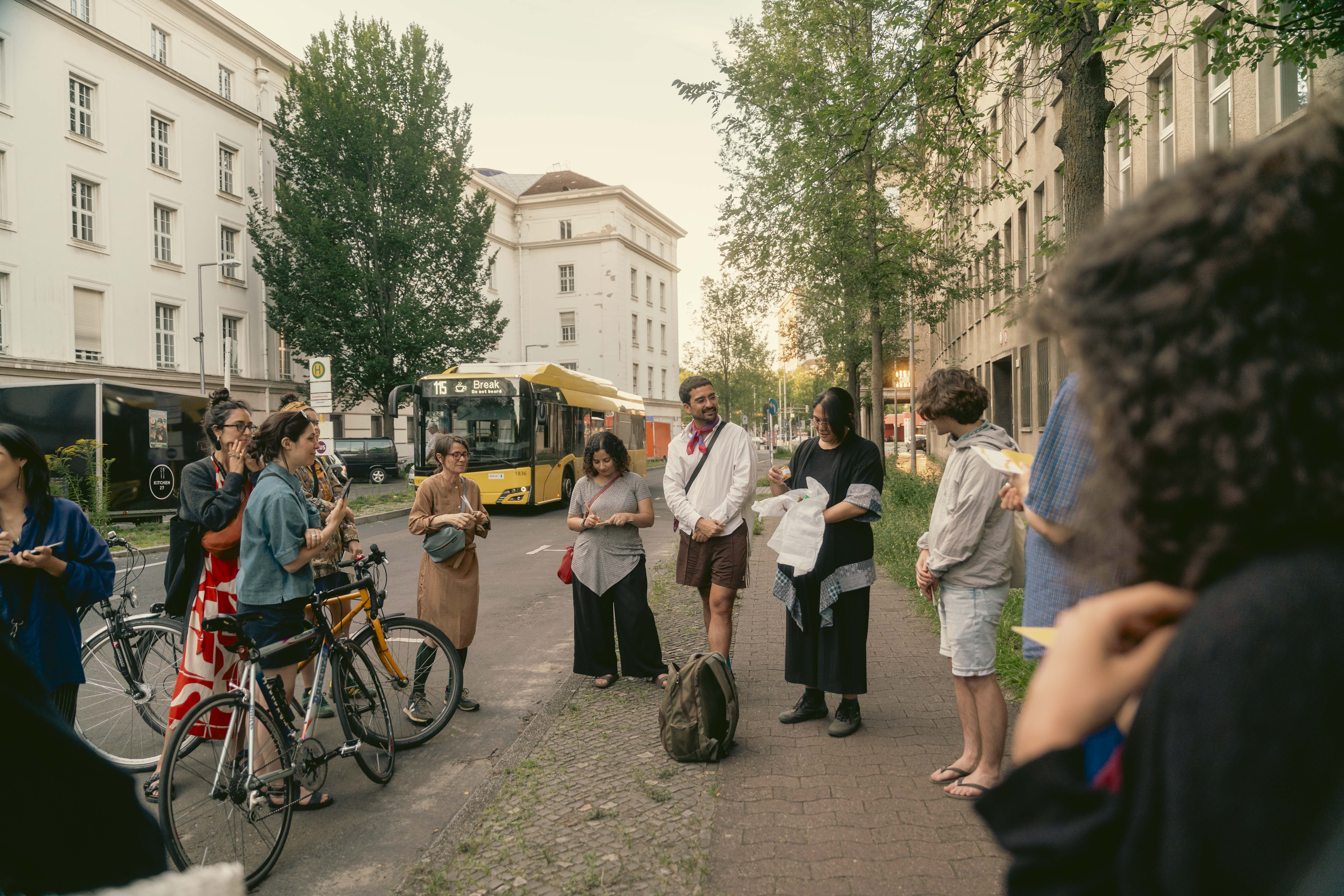

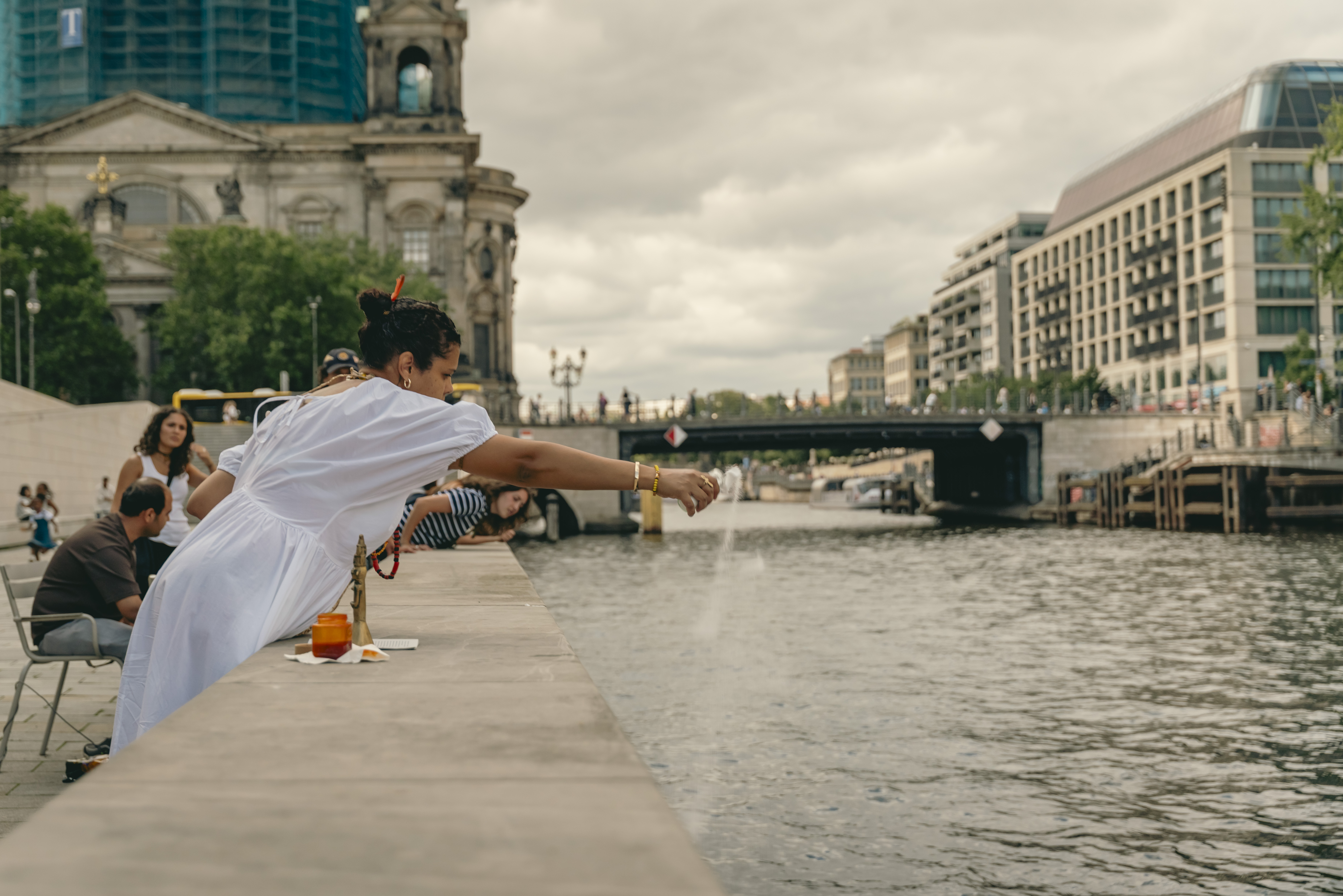


artist contributions by Saverio Cantoni, Harun Morrison, Suelen Calonga, Pitchaya Ngamchareon and Lauryn Youden;
photos by Lucía Alfaro
Dissident Paths: Walking Together as a Method
a project by Cruising Curators and The ReRouting Project
"When does walking become a refusal, a reclaiming, a reimagining? What stories does the city whisper when you move through it at different paces? What forms of knowledge emerge when we walk together, rather than alone?
Dissident Paths is a curatorial project unfolding over a year, by means of collective movement along traced, imagined, and yet-to-be-discovered paths across Berlin. Walking can be both a necessity and a gesture of dissidence, a refusal to accept the given infrastructures of a world increasingly defined by polarization and devastation. Walking through the city can change perceptions and awareness, at once exposing barriers and impossibilities, whilst also opening up new routes. Movement, in both its bodily and political forms, holds the potential to reshape our sense of belonging and collective agency."
See more at nGbK website.
︎
3-day public program coming up at nGbK space (Alexanderplatz) on February 26th-28th, 2026.
︎
3-day public program coming up at nGbK space (Alexanderplatz) on February 26th-28th, 2026.
teaching
![]()
![]()
![]()
![]()
![]()
![]()
![]()
![]()
![]()
![]()
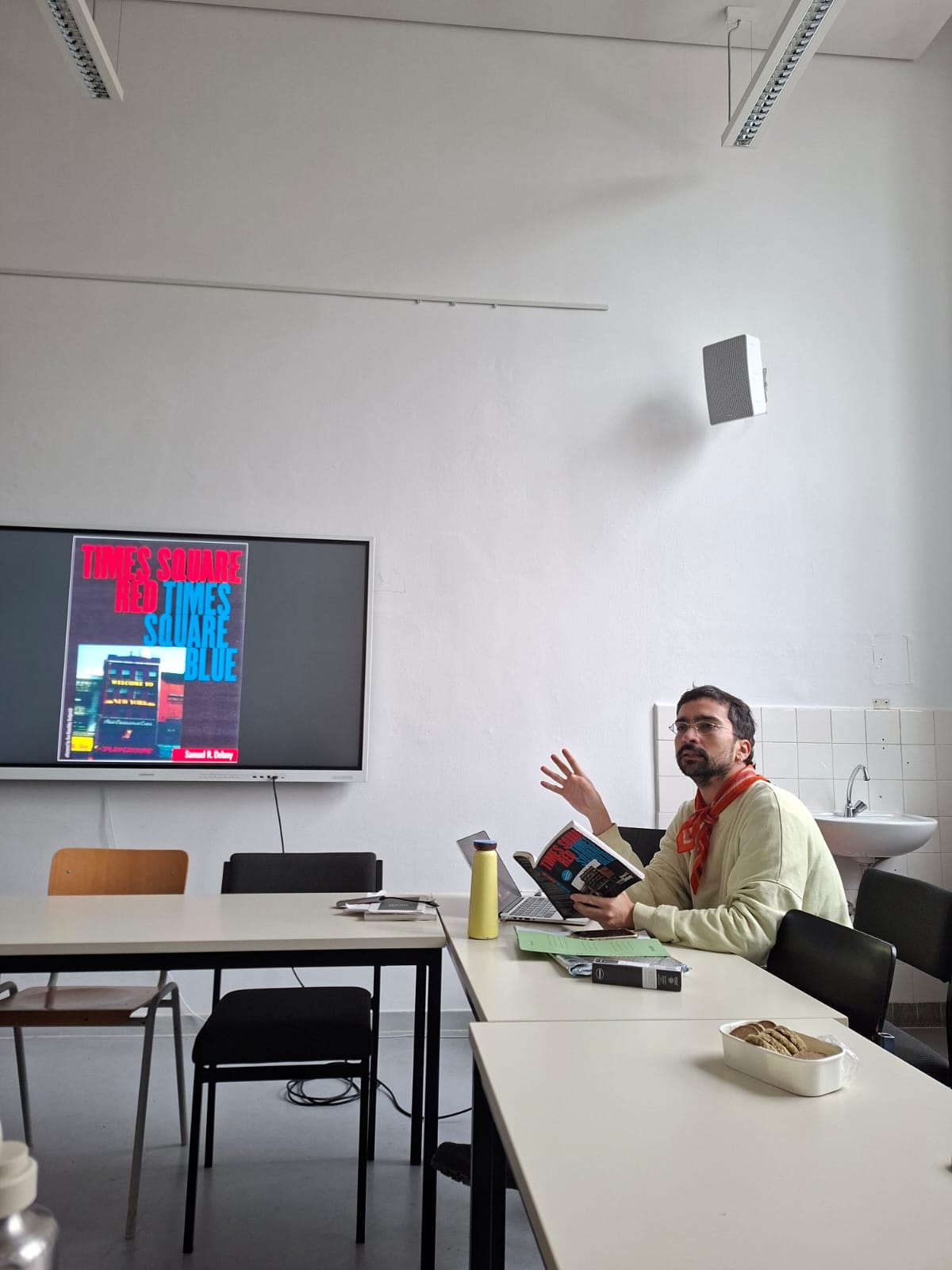

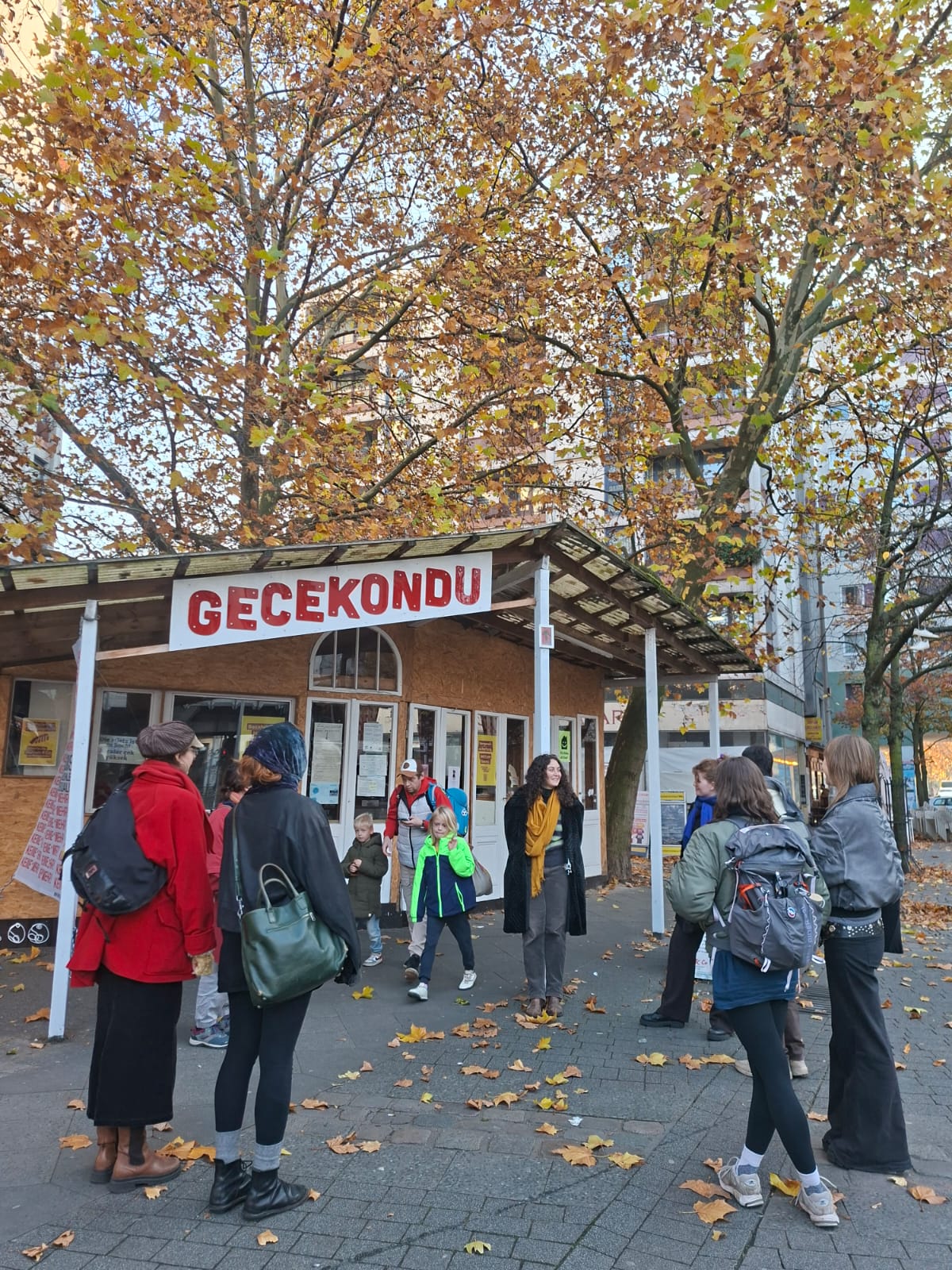
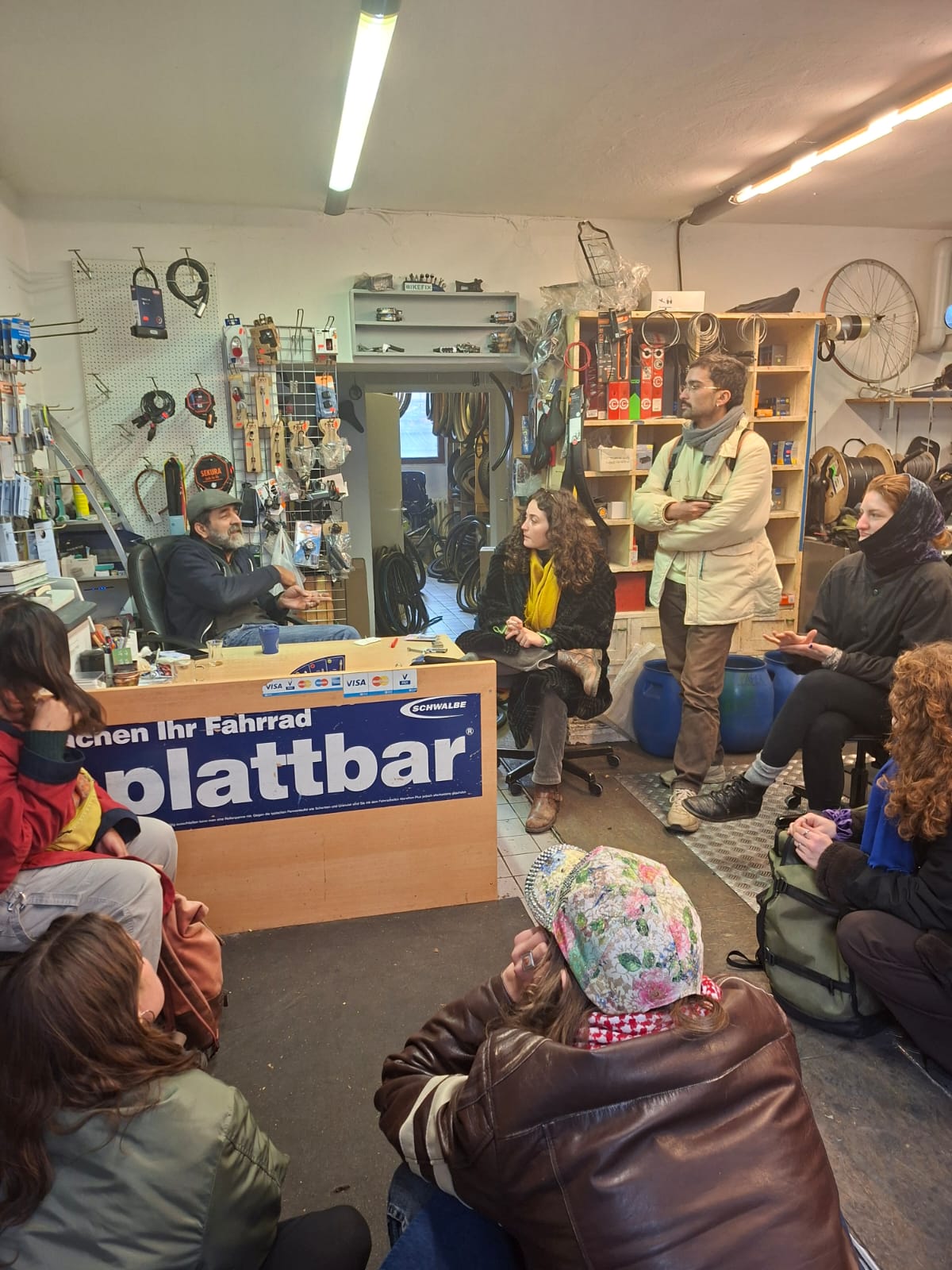


Curatorial Practice as Contact
seminar at UdK ~ winter semester 2025/2026
seminar description:
„§2.1. Contact is the conversation that starts in the line at the grocery counter with the person behind you while the clerk is changing the paper roll in the cash register. It is the pleasantries exchanged with a neighbor who has brought her chair out to take some air on the stoop. It is the discussion that begins with the person next to you at a bar. It can be the conversation that starts with any number of semiofficials or service persons—mailman, policeman, librarian, store clerk or counter person. As well, it can be two men watching each other masturbating together in adjacent urinals of a public john—an encounter that, later, may or may not become a conversation.”
(Times Square Red, Times Square Blue, Samuel R. Delany, p. 123, 1999)
This seminar was an open invitation to “think, act, recollect, fuse and circulate together with our communities-to-be”, as Cruising Curators collective proposes with their practice. Drawing primarily from queer writer Samuel R. Delany’s notion of contact, the main idea is to study – in an improvisational and being together sense of the word, as put by Fred Moten and Stefano Harney – the curatorial as a practice focused on the coincidental, the ephemeral and meaningful encounters a city can provide.
seminar at UdK ~ winter semester 2025/2026
seminar description:
„§2.1. Contact is the conversation that starts in the line at the grocery counter with the person behind you while the clerk is changing the paper roll in the cash register. It is the pleasantries exchanged with a neighbor who has brought her chair out to take some air on the stoop. It is the discussion that begins with the person next to you at a bar. It can be the conversation that starts with any number of semiofficials or service persons—mailman, policeman, librarian, store clerk or counter person. As well, it can be two men watching each other masturbating together in adjacent urinals of a public john—an encounter that, later, may or may not become a conversation.”
(Times Square Red, Times Square Blue, Samuel R. Delany, p. 123, 1999)
This seminar was an open invitation to “think, act, recollect, fuse and circulate together with our communities-to-be”, as Cruising Curators collective proposes with their practice. Drawing primarily from queer writer Samuel R. Delany’s notion of contact, the main idea is to study – in an improvisational and being together sense of the word, as put by Fred Moten and Stefano Harney – the curatorial as a practice focused on the coincidental, the ephemeral and meaningful encounters a city can provide.
With the brilliant participation of guests Ana Druwe, Luise Leon Elbert (Cruising Curators), Clementine Butler-Gallie (ReRouting Project), Cláudio Bueno and students: Sana Al-Kurdi, Ben Behrends, Mina Buker, Maria Eglau, Paulina Graw, Jiwoo Lee, Paula Pleuser, Mira Reeh and Luna Schamal.
artistic research


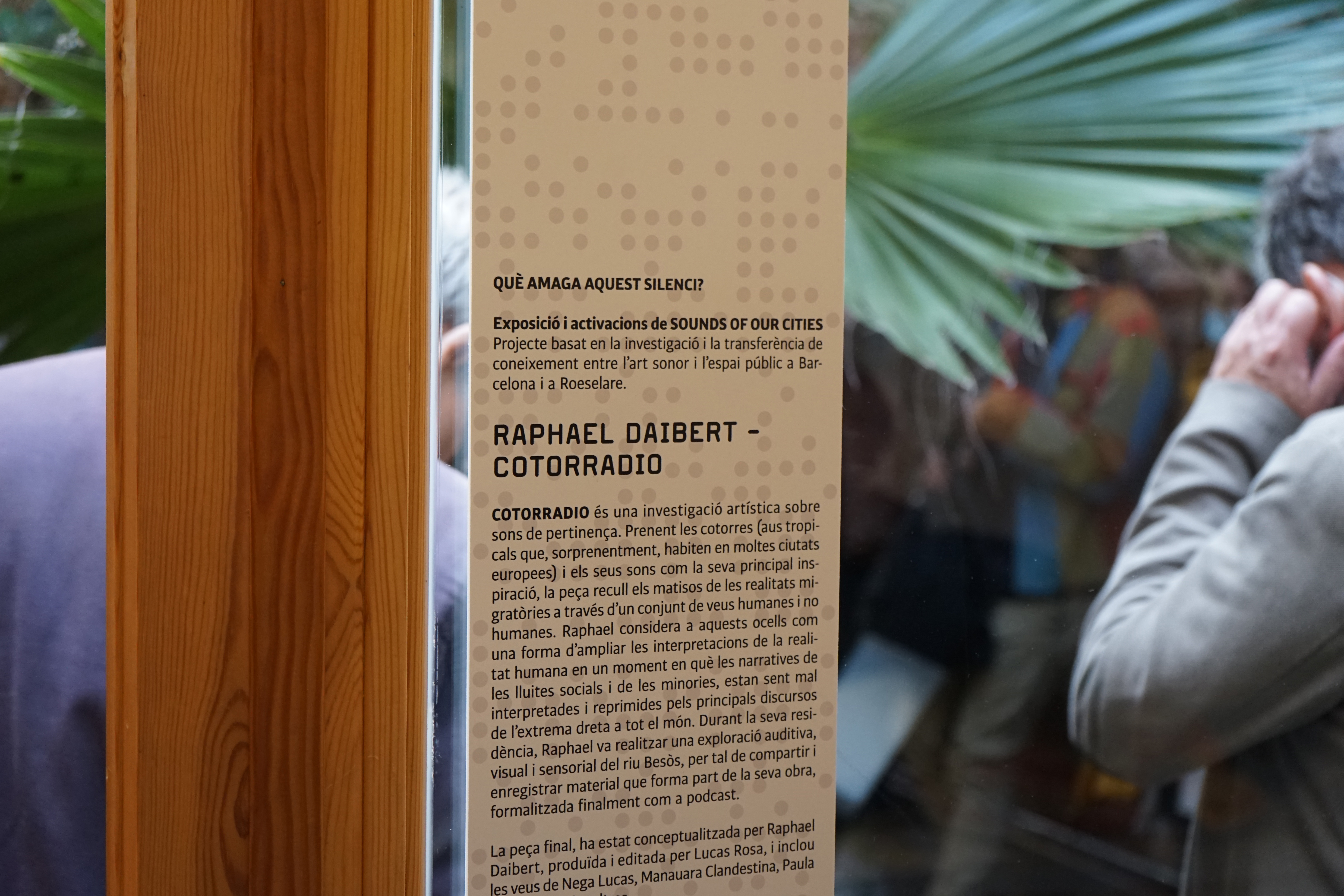


Cotorradio is an artistic research project that tackle questions based on ecology, migration, more-than-human histories and the urban endeavor. In April 2021, it was hosted by Idensitat in Barcelona with the intention to seek for sounds of belonging – having the sound of tropical parakeets found in European cities as its centrality. A sound piece and a sound-walk came together after almost a month in the city.
The sound piece with the ensemble of sounds and voices recorded during the residency process brought together not only the sounds of the birds, but also of the queer and migrant community that hosted the artist. The sound-walk happened throughout the Besòs river length, departing from a nest of cotorras (parakeets in Spanish) on a palmtree – depicted in one of the photos above – leading to the river's estuary where a known cruising area is located.
In September 2021, in the context of the exhibition Què amaga aquest silenci?, where the sound piece was installed, a sound-walk bursting the recorded voices happened throughout the streets of Sant Andreu, the district of Barcelona where the project was hosted.
The sound piece with the ensemble of sounds and voices recorded during the residency process brought together not only the sounds of the birds, but also of the queer and migrant community that hosted the artist. The sound-walk happened throughout the Besòs river length, departing from a nest of cotorras (parakeets in Spanish) on a palmtree – depicted in one of the photos above – leading to the river's estuary where a known cruising area is located.
In September 2021, in the context of the exhibition Què amaga aquest silenci?, where the sound piece was installed, a sound-walk bursting the recorded voices happened throughout the streets of Sant Andreu, the district of Barcelona where the project was hosted.
︎To listen to cotorradio, please access:
https://soundcloud.com/rdaibert/cotorradio
Produced and edited by Lucas Rosa
Voices from Nêga Lucas, Manauara Clandestina, Paula Daibert & many others.
In loving memory of Nêga Lucas.
Photos by Albert Gironès, Raphael Daibert.
https://soundcloud.com/rdaibert/cotorradio
Produced and edited by Lucas Rosa
Voices from Nêga Lucas, Manauara Clandestina, Paula Daibert & many others.
In loving memory of Nêga Lucas.
Photos by Albert Gironès, Raphael Daibert.